World Homeless Day: Building Pathways Out of Homelessness
Across the UK, the housing crisis continues to deepen. Record waiting lists, shrinking availability of affordable homes, and increasing demand for temporary accommodation are pushing more households into housing insecurity.
Amid these challenges, Homefinder UK, the national housing mobility scheme run by Home Connections, is providing a lifeline. By connecting individuals and families willing to relocate with safe, affordable, long-term housing, Homefinder UK is helping people break free from cycles of instability.
World Homeless Day and Homefinder UK’s Mission
Every year on 10th October, World Homeless Day shines a light on the realities of homelessness and the urgent need for lasting solutions. It’s a moment to recognise the scale of the challenge and the innovative approaches that are making a difference.
This day underscores Homefinder UK’s mission: helping people find the security of a home and the chance to rebuild their lives.
Whitepaper Coming Soon
Later this year, Homefinder UK will release a new whitepaper based on its most recent national survey of households supported through the scheme. The findings highlight both the scale of housing need and the transformative impact of relocation support.
Here’s a preview of what our upcoming whitepaper reveals:
- Over half (54%) of respondents faced homelessness or eviction before turning to Homefinder UK
- More than 1 in 5 had been searching for permanent housing for over 5 years
- Respondents reported significant improvements, including better mental health, lower housing costs, and living in safer neighbourhoods
- High satisfaction levels: Over 70% were ‘very satisfied’ with the support received from Homefinder UK
Fill out this short form to receive an update as soon as Homefinder UK's upcoming whitepaper is released.
Real Impact, Real Change from Housing Solutions in Action
Homefinder UK has helped more than 1,800 people and families relocate to safe, long-term housing – including over 230 survivors of domestic abuse and dozens of rough sleepers. The scheme works by helping those prepared to move to a new location by offering them to affordable and available housing in different parts of the country. For those who take up this option it can offer a route to permanent and suitable housing.
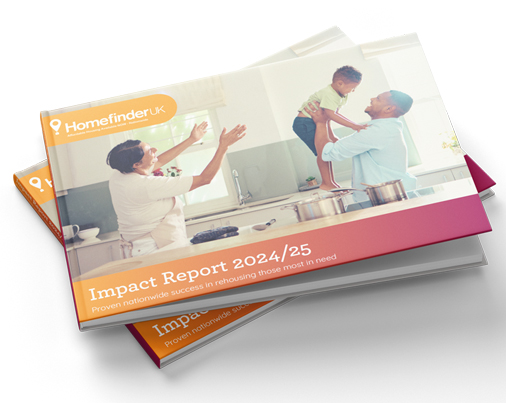
The Homefinder UK 2024/25 Impact Report reveals that the scheme provides direct relocation support and delivers substantial cost savings to local authorities. In 2024/25 alone, the scheme saved councils over £3 million in temporary accommodation costs, while maintaining a tenancy failure rate of less than 1% which is significantly lower than national averages.

Download Homefinder UK's 2024/2025 Impact Report
Sharon Roberts, Head of Lettings at Southern Housing and Chair of Homefinder UK said: “We know that a safe, secure home is the foundation for everything else – from education to employment and recovery - This impact is only possible because of our dedicated team, our local authority and housing association partners, and the individuals who trust us with their journey.”
StreetLink: Be the Link That Connects Someone to Support
Homelessness can affect anyone, and spotting the signs early can help save lives. Through StreetLink, members of the public can connect people sleeping rough to local outreach teams who can offer support, shelter, and safety.
Since its launch, the platform has enabled over 219,000 alerts across England and Wales, each one a vital step toward ending rough sleeping.
This World Homelessness Day, StreetLink is also launching its new Impact Stories Hub — a space to read real stories of people helped through alerts, and to see how collective action creates real change.
If you see someone sleeping rough, make a StreetLink alert today at thestreetlink.org.uk
Together, We Can Create Pathways Out of Homelessness
World Homeless Day is a reminder that behind every statistic is a person and someone seeking safety, stability, and the chance to rebuild. Homefinder UK remains committed to turning that hope into reality by connecting people to homes that change lives.
With the continued support of Homefinder UK’s amazing partner local authorities and housing associations, it can expand the pathways out of homelessness and housing insecurity.
Are You a Local Authority or Housing Provider? Help Homefinder UK change more lives. Contact Homefinder UK.
World Homelessness Day: Helping People Find Support Through StreetLink
Every year on 10th October, communities across the world mark World Homelessness Day – a chance to shine a spotlight on the realities of homelessness and explore how we can all make a difference.
In the UK, homelessness remains a pressing issue. It affects thousands of individuals and families, from those sleeping rough on our streets to people living in temporary accommodation or moving from sofa to sofa with no place to call home. Behind every statistic is a person – someone’s friend, parent, child – facing daily struggles that most of us can barely imagine. As the colder months draw in, it’s a timely reminder of the importance of compassion, awareness, and action.
The Reality of Homelessness
Homelessness isn’t just about the absence of a roof. It affects every part of a person’s life:
- Health: Sleeping outside in the cold and damp leads to severe health risks, from respiratory illnesses to hypothermia. Life expectancy for people experiencing rough sleeping is tragically decades lower than average.
- Safety: Many rough sleepers experience violence, theft, or abuse while on the streets. Each night is not only uncomfortable, but unsafe.
- Mental wellbeing: Living without security or stability takes a huge toll on mental health. Anxiety, depression, and isolation are common, creating a cycle that makes it even harder to recover.
Across the UK, an estimated 272,000 people are experiencing homelessness. In England alone, the government’s most recent snapshot recorded 4,667 people sleeping rough on a single night in Autumn 2024 – a 20% increase from the year before. These numbers remind us that homelessness is not just a local issue, but a national challenge.
How StreetLink Helps
It’s easy to feel powerless when you see someone sleeping rough – but you can help. StreetLink is a national service that enables the public to connect people sleeping rough with local support.
Here’s how it works:
- Spot someone in need. If you see a person bedding down outside, or if you’re concerned about someone who may be sleeping rough, you can act.
- Send an alert. Visit StreetLink.org.uk. You’ll be asked for details such as location, time seen, and a brief description.
- Outreach teams respond. Your alert is passed to local homelessness outreach teams, who go out to find the individual and offer help. This may include emergency shelter, medical care, or longer-term housing options.
StreetLink doesn’t provide housing directly, but it plays a vital role in making sure no one goes unseen. Since its relaunch in September 2023, StreetLink has received over 219,000 alerts from the public, helping outreach teams connect with people sleeping rough and offer support that could change their life.
Real Stories: Case Studies Hub
This World Homelessness Day, we’re launching a new Case Studies page on the StreetLink hub. The page shares real stories showing the difference a StreetLink alert can make, highlighting the partnerships and people behind the work.
These stories bring the statistics to life – showing how alerts translate into real-world impact.
Impact Story: Ben and Cali
StreetLink’s impact can be life-changing. One powerful example comes from our partnership with StreetVet, which supports people experiencing homelessness and their pets.
When a StreetLink alert was made for Ben and his dog Cali, StreetVet volunteers were able to step in quickly. Cali received urgent veterinary treatment for a serious health issue, while Ben was supported with supplies and guidance so the pair could remain together safely.
This case shows how a single alert can spark vital support – not just for individuals, but also for the companions who mean the world to them. Read the full story of Ben and Cali.
How You Can Support This World Homelessness Day
- Use StreetLink: If you see someone sleeping rough, don’t walk past. Take two minutes to send an alert via StreetLink.org.uk. It could change someone’s life.
- Support local services: Donate to or volunteer with local charities and shelters that provide food, warmth, and longer-term support.
- Show compassion: A kind word or small act of generosity can help someone feel seen and valued in a world where they often feel invisible.
- Spread awareness: Share information about StreetLink with friends, family, and on social media. The more people who know how to act, the more people we can connect to support.
A Collective Effort
Homelessness is a challenge that requires everyone – councils, charities, volunteers, and the public – to work together. This World Homelessness Day, let’s remember that each of us has a role to play.
By raising awareness, showing compassion, and using StreetLink to connect people to support, we can make a tangible difference in people’s lives. Because no one should have to sleep rough.
Case Study: StreetLink & StreetVet – A Partnership Supporting People Sleeping Rough and Their Pets
In February 2024, StreetLink and StreetVet launched an innovative partnership aimed at addressing the often-overlooked needs of people sleeping rough with pets. With up to one in four people experiencing homelessness in the UK accompanied by an animal, this initiative recognised the critical role pets play in their owners’ wellbeing — and the barriers they face in accessing support.
Through this new integration, members of the public and individuals self-referring can now indicate if they are accompanied by a pet when submitting a StreetLink alert. This directly triggers a notification to StreetVet, enabling a rapid response from their volunteer clinical teams to assess and support both the animal and their owner.
The impact
Since launch, over 240 referrals to StreetVet have been made via StreetLink, representing around 6–9% of StreetVet’s total monthly referrals. While only a small proportion of these lead to direct intervention, the wider impact has been significant — increasing public awareness, improving referral accuracy for outreach teams, and expanding access to care for a highly marginalised group.
As Collette Sheaff from StreetVet explains:
“Our collaboration with StreetLink has been impactful, ensuring that referrals received mentioning a pet come directly to StreetVet for investigation by our Clinical Team. This partnership has not only increased awareness of the vital support we provide for individuals experiencing homelessness with a pet but also allowed us to reach owners who may not have known how to find us before. Together, we’re making a meaningful difference.”
StreetVet’s support ranges from preventive and emergency treatment to providing food, toys, harnesses, blankets, and other essentials — helping owners maintain the companionship that is often central to their resilience and wellbeing.
Case example: Ben* and Cali
One powerful example of this partnership in action involves a referral for an individual named Ben and his dog, Cali. After a member of the public used StreetLink to highlight their situation, StreetVet volunteers conducted an outreach visit. Cali was found to be suffering from several untreated health issues, including a mammary mass requiring surgery.
Thanks to the StreetLink referral, Cali was promptly assessed, treated by a local veterinary practice, and continues to receive care. StreetVet also supports Ben with essential supplies and guidance, ensuring the pair can stay together safely and healthily. This case shows how early intervention through StreetLink can prevent worsening health conditions for both pet and owner.
Broader significance
This collaboration bridges a crucial service gap. Many vulnerable individuals are reluctant to access accommodation or healthcare if it means being separated from their animal companions. By ensuring pets are supported too, StreetLink and StreetVet lower access barriers to services and foster trust between outreach teams and those in need.
The partnership also encourages more meaningful public engagement. When people know their actions can help both a person and their animal companion, they are more likely to make a StreetLink alert and take part in community-led solutions to homelessness.
How you can help
Every action counts. You can support this initiative by:
- Raising a StreetLink alert: If you see someone sleeping rough, submit an alert and include pet details if visible.
- Sharing awareness: Tell others about StreetLink and StreetVet’s work so more people understand how to help.
- Collaborating locally: If you work in housing, outreach, or animal welfare, explore partnership opportunities with StreetLink and StreetVet.
Together, StreetLink and StreetVet are reshaping how services respond to homelessness — proving that small, thoughtful innovations can create meaningful, lasting change.
*Please note: Names have been changed.
Homefinder UK Rehouses 1,800+ Homeless and Vulnerable Households
Homefinder UK, the national housing mobility scheme run by Home Connections, has released its 2024/25 Impact Report, showcasing the scale and significance of its work to tackle the UK’s housing crisis.
Amid record-breaking waiting lists and a chronic shortage of affordable homes, Homefinder UK has helped more than 1,800 people and families relocate to safe, long-term housing – including over 230 survivors of domestic abuse and dozens of rough sleepers. The scheme works by helping those prepared to move to a new location by matching them to affordable and available housing in different parts of the country. For those who take up this option it can offer a route to permanent and suitable housing.
The report reveals that Homefinder UK not only provides direct relocation support, but also delivers substantial cost savings to local authorities. In 2024/25 alone, the scheme saved councils over £3 million in temporary accommodation costs, while maintaining a tenancy failure rate of less than 1% which is significantly lower than national averages.
“You didn’t just give me a place to live; you gave me a chance to rebuild my life,” said one applicant, who was rough sleeping in Bristol before moving to permanent social housing in Cheshire.
With 24,000+ calls handled yearly by its team and a growing network of more than 100 housing partners across the country, Homefinder UK offers wraparound case management, relocation funding, and tailored support for a diverse range of vulnerable people – including refugees, people with accessibility needs, and those fleeing unsafe living conditions.
Sharon Roberts, Head of Lettings at Southern Housing and Chair of Homefinder UK said: “We know that a safe, secure home is the foundation for everything else – from education to employment and recovery.”
“This impact is only possible because of our dedicated team, our local authority and housing association partners, and the individuals who trust us with their journey.”
As the housing crisis deepens, the report outlines Homefinder UK’s future commitments, including:
- Expanding local housing options for people wanting to stay near family or work
- Doubling relocation support funding through funding partnerships
- Strengthening accessible housing pathways for disabled applicants
- Increasing employment, training and wellbeing support for rehoused applicants
Only 2.5% of private properties are now affordable (using LHA rates as the measure of affordability) and most of these are located in lower demand areas of the country. The scheme is calling on greater urgency from the government to fulfil its promises to build social housing and to provide more financial support for relocation schemes.
To download the report visit: https://homefinderuk.org/impact-report-2024-25
How Effectively Are We Addressing Damp and Mould in Social Housing?
Over the 20 years Home Connections has provided solutions to the social housing sector, a recurring issue we've encountered is the quality of properties advertised and the impact this has on tenants’ health and wellbeing. The recent tragic death of Awaab Ishak has highlighted the need for proactive action in this area. As a social enterprise, we are committed to exploring innovative solutions that will improve housing conditions for all.
Our recent #ConnectWednesdays webinar, “Damp and Mould in Housing: Are We Addressing It Effectively?”, brought together experts who shared vital insights into effectively managing damp and mould. Key speakers, Simon Kilshaw, Green Doctor Manager at Groundwork Yorkshire, and Leonard Carey, Co-Founder & CEO of DampSmart, led a series of discussions with the audience.
How do you decide if damp and mould problems are caused by tenant habits or the building fabric?
One of the main challenges in tackling damp and mould is determining whether the issues stem from the building's fabric or the internal environment. This distinction directly influences the type of intervention required.
The Impact of Awaab's Law
The introduction of Awaab’s Law from October 2025 will require social landlords to investigate and resolve dangerous damp and mould issues within strict timeframes and repair all emergency hazards within 24 hours.
When asked about the impact of Awaab's Law, one audience member explained that their housing repairs team initially operated with a seven-day deadline, using a triage system to categorise cases as either 28 days or 7 days. While they plan to maintain this approach, adjustments will be needed when the law takes effect in October. Although they have few high-priority (Category 1) cases present, clarifying what constitutes a 24-hour emergency versus what can be addressed within 14 days will be essential. The full impact of the law remains uncertain at this stage.
Addressing Bias in Assessments
As noted by some participants, there is still a tendency to blame tenant lifestyle as a reason for damp and mould issues without thorough investigation, resulting in unresolved problems and tenant dissatisfaction.
One attendee shared a case study of a tenant who reported a damp smell within 25 days of moving in, but no action was taken. When concerns were raised again at the three-month visit, they were ignored. At the nine-month visit, concerns about the accumulation of items in the property were noted, and it wasn’t until three years later that a proper investigation was conducted. The cause was found to be a combination of poorly fitting doors, roof tiles, and other structural issues that contributed to the damp. This highlights the urgent need to confront unconscious biases in assessments.
Supporting Tenants Through Education
Another attendee shared that their current work focuses on supporting the education of tenants about the health impacts of damp and mould, as well as simple steps they can take to improve their living conditions. After implementing awareness sessions, tenant knowledge surged from a rating of 3/5 to 5/5. There is strong interest among tenants to try new approaches, and the team plans to follow up after three months to assess what changes have been implemented and their effectiveness.
Monitoring Conversions from Office Blocks to Flats
A significant source of damp and mould arises from the conversion of office blocks into residential flats. In severe cases, this necessitates relocating tenants to alternative accommodation.
Simon Kilshaw emphasised the importance of monitoring these conversions rigorously, particularly when buildings are retrofitted from commercial to residential use, to ensure they are suitable for habitation and to prevent damp and mould problems.
What are the financial and resource challenges in managing complex social and building fabric issues?
Addressing damp and mould effectively demands substantial financial and human resources. However, many social housing providers are grappling with budget cuts, staffing shortages, and overwhelming demand for repairs.
Shortage of staff
One attendee mentioned that a shortage of repair personnel and trades people hinders their ability to assess and fix damage. With the introduction of tighter timelines, there simply isn't enough workforce to meet the demand, making it one of their biggest challenges currently.
Maintenance for Historic and Listed Buildings
Managing buildings that are over 100 years old and all Grade 2 listed was also raised as a unique challenge for one local authority. This adds significant complexity to maintenance and repairs, as well as any upgrades or additions, due to the additional paperwork and regulations required for listed buildings.
Heating on Prescription
Leonard Carey discussed the rising issue of heating costs, noting that in some cases, landlords are subsidising the cost of heating for tenants when there is a clear need for increased heating. Simon Kilshaw mentioned a pilot initiative in Leeds called "Heating on Prescription", which has continued beyond the pilot phase.
How do you measure good outcomes for you and the tenant?
To measure successful outcomes for both the service provider and tenants, Simon Kilshaw explained that a baseline measurement should be taken before any intervention, followed by post-data collection. This comparison helps determine whether the outcome has been successful.
He emphasised the importance of both qualitative and quantitative approaches. Leonard added some examples of how Dampsmart and Green Doctors have worked together to get to the bottom of structural issues and assistance that individuals need to stay warm and dry in their homes. Follow ups need to be inclusive and take account of the different methods people like to give feedback. In some cases it may be time consuming but in the end it does help plan better services.
Take Action on Damp and Mould
Addressing damp and mould in social housing requires a comprehensive approach that combines effective solutions, adequate resources, and a focus on long-term improvements.
By becoming a DampSmart Leader, you’ll gain exclusive access to a detailed property inspection using advanced sensor technology in each room and data analytics, and the opportunity to make a tangible impact in your community.
What Does a DampSmart Leader Receive?
✅ A free advanced property diagnosis kit
✅ An in-depth, data-driven, 2-week damp & mould property analysis
✅ Tailored insights to improve property resilience
✅ The chance to shape best practices for the industry
As a DampSmart Leader, you’ll join a select group of professionals working to drive real change and improve housing conditions at scale.
If you're interested in exploring how Home Connections and DampSmart can support your organisation, simply fill out our contact form and include ‘DampSmart Leader’ in your message.
Take the First Step – Become a DampSmart Leader Today!Introducing the DampSmart Leader Initiative – A Chance to Access Cutting-Edge Damp & Mould Solutions
The conversation around damp and mould in housing is evolving, and we want to ensure that landlords have the right tools, data, and insights to address these challenges effectively. Last Thursday, the government announced that Awaab’s Law will be enforced for damp and mould in the social rented sector starting from October 2025, with plans to extend this to a wider range of housing hazards by 2026.
This highlights the urgency for landlords to act now and adopt proactive solutions. That’s why DampSmart and Home Connections are excited to introduce the DampSmart Leader Initiative, a unique opportunity to gain firsthand access to advanced property diagnostics and best practices, from a community of landlords (just like you), tenants and contractors.
Join Our #ConnectWednesdays Webinar & Enter the Draw
Our upcoming #ConnectWednesdays webinar— “Damp and Mould in Housing – Are We Addressing It Effectively” will kick off a new era of collaboration with our customers and partners to create and share new ways to protect buildings, provide safer homes for tenants and better outcomes for landlords.
#ConnectWednesdays: Damp and Mould in Housing – Are We Addressing It Effectively
Date & Time: Wednesday, 12th February, 12:00 PM – 1:00 PM
Where: Online via Zoom
To make this even more valuable, we are offering an exclusive opportunity for attendees:
Become a DampSmart Leader & Win a Free Advanced Inspection
By completing the short pre-webinar questionnaire, you’ll be entered into a draw for a free trial of DampSmart’s advanced technology and services. Winners will gain exclusive access to an in-depth ‘fabric and environment’ inspection of one of their worst-affected homes.
What Does a DampSmart Leader Receive?
✔ A free advanced property diagnosis kit
✔ An in-depth damp & mould property inspection
✔ Tailored insights to improve property resilience
✔ The chance to shape best practices for the industry
As a DampSmart Leader, you’ll be part of a select group driving real, practical change in how we tackle damp and mould at scale.
Key Questions We’ll Be Tackling
During the session, Leonard Carey, Co-Founder & CEO of DampSmart, and Simon Kilshaw, Green Doctor Manager at Groundwork Yorkshire, will explore crucial questions, such as:
- How do you determine if damp and mould issues stem from the internal environment or the building fabric?
- What are the financial and resource challenges in managing complex social and structural issues?
- How do you measure successful outcomes for both landlords and tenants?
How to Enter the Draw
2. Complete the short pre-webinar questionnaire
3. Winners will be announced after the webinar
Don’t miss this opportunity to gain practical solutions, test groundbreaking technology, and become a leader in housing innovation!